





Small-Batch CNC Machining Quality Control: From First Part to Final Batch
Small-Batch CNC Machining Quality Control: From First Part to Final Batch
Small-batch CNC machining is not simply mass production with fewer parts.
When an order contains only 5, 20, 50, or 100 components, every part represents a larger percentage of the total order. A single dimensional problem can affect the usability of the entire batch.
For this reason, effective quality control should not start at final inspection. It should begin with drawing review, material verification, process planning, first-piece inspection, in-process checks, and final inspection.
At Pincheng Model, we treat quality as a continuous process—from the first drawing review to the final shipment.

Why Quality Control Matters in Small-Batch CNC Machining
Small-batch CNC projects often involve prototypes, engineering validation, replacement parts, pilot production, and low-volume manufacturing.
These components may include:
- Tight dimensional tolerances
- Complex geometries
- Multiple machining setups
- Critical hole positions
- Flatness and parallelism requirements
- Precision mating surfaces
- Specific surface finishes
- Anodizing or other surface treatments
A small production quantity does not necessarily mean a simple manufacturing process.
In many cases, a 20-piece order requires the same level of engineering attention as a much larger production run.
The key question is therefore not simply how many parts are being produced, but:
How can the manufacturing process remain stable from the first part to the last?
1. Drawing and Requirement Review
Quality control begins before the CNC machine starts cutting.
Before production, the latest 2D technical drawing and 3D CAD model should be reviewed carefully.
The engineering review focuses on:
- Critical dimensions and tolerances
- GD&T requirements
- Datum references
- Hole diameters and positions
- Threads
- Flatness and parallelism
- Surface roughness
- Material requirements
- Surface treatment
- Engraving or marking
- Inspection and documentation requirements
This step helps identify potential manufacturing or inspection issues before production begins.
If a requirement is unclear, it is much better to clarify it before machining than to discover the issue after the entire batch has been produced.

2. Material Verification
The correct material is the foundation of a qualified CNC component.
Before production, material information should be verified according to the project requirements, including:
- Material grade
- Material size
- Material batch
- Material certificate
- Heat treatment condition, when applicable
- Surface condition
For example, 6061 aluminum and 7075 aluminum may look similar, but they have different mechanical properties and machining characteristics.
Using the wrong material cannot be corrected by dimensional inspection later.
That is why material verification is an important part of the overall quality-control process.

3. First-Piece Inspection
One of the most important steps in small-batch CNC machining is first-piece inspection.
Before continuing with the full batch, the first machined part can be inspected against the customer's drawing.
The objective is straightforward:
Confirm that the machining process and setup are correct before producing the remaining parts.
The first-piece inspection may focus on:
- Overall dimensions
- Critical dimensions
- Hole diameters and positions
- Threads
- Datum surfaces
- Flatness
- Parallelism
- Perpendicularity
- Other critical features
For complex components, CMM inspection can provide more detailed dimensional and geometric data.
If an important dimension is outside tolerance, the process can be corrected before the same problem is repeated throughout the batch.

4. In-Process Inspection
Passing the first-piece inspection does not mean quality control is finished.
During production, dimensional variation can occur due to:
- Tool wear
- Tool deflection
- Cutting forces
- Fixture movement
- Thermal changes
- Machine conditions
- Material variation
- Changes between machining setups
For this reason, critical dimensions should be monitored during production.
The inspection frequency can be adjusted according to the part's:
- Geometry
- Tolerance requirements
- Production quantity
- Application
- Manufacturing risk
Critical features may be checked after the first part, during production, after tool changes, or after a machining setup change.
This helps identify potential dimensional drift before it affects the entire batch.
5. CMM Inspection for Critical Features
For precision CNC components, conventional measuring tools are not always sufficient.
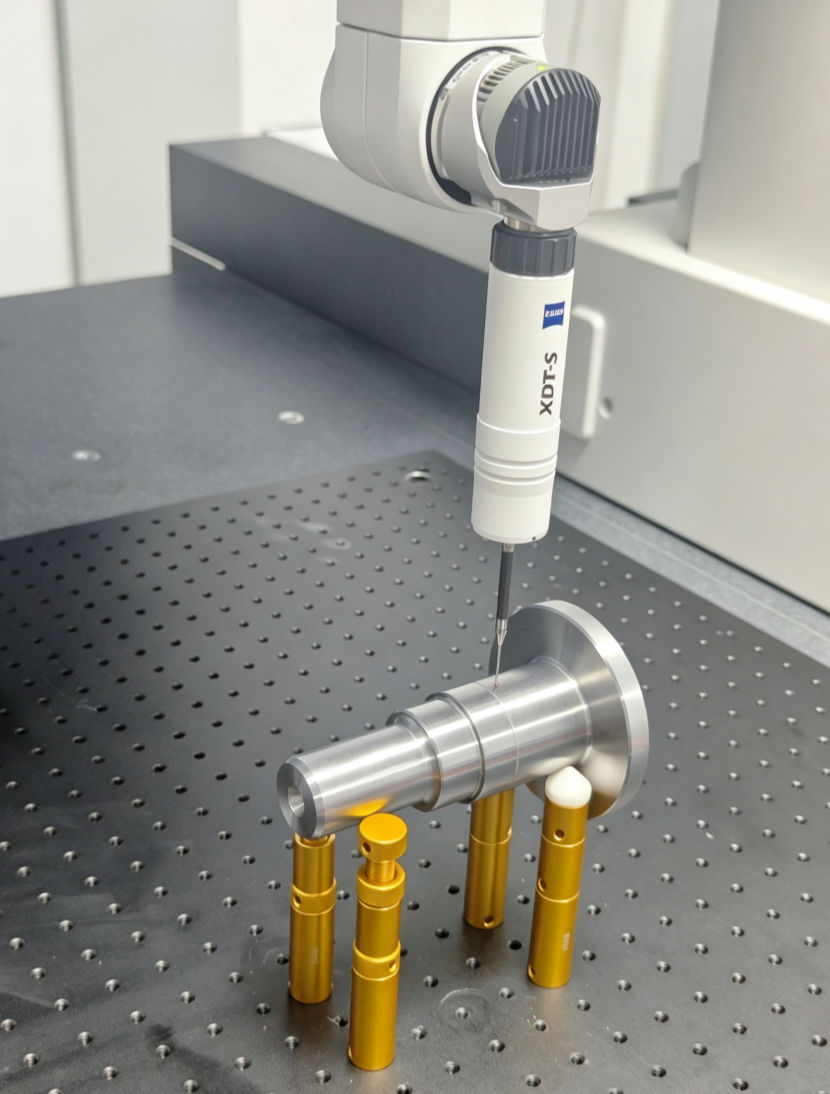
A Coordinate Measuring Machine (CMM) can be used to inspect dimensional and geometric relationships between different features.
Typical applications include:
- Position
- Flatness
- Parallelism
- Perpendicularity
- Concentricity
- Profile
- Hole location
- Datum relationships
- Complex 3D features
A component may have individual dimensions within tolerance but still have an assembly problem if the relationship between two features is incorrect.
This is why geometric inspection can be particularly important for precision components.
For critical small-batch projects, CMM inspection provides measurable inspection data rather than relying only on visual judgment.
6. Surface Finish Inspection
Dimensional accuracy is only one part of CNC machining quality.
Depending on the application, small-batch CNC parts may require:
- Anodizing
- Hard anodizing
- Bead blasting
- Polishing
- Black oxide
- Other specified surface treatments
Surface treatment can affect both appearance and dimensions.
Quality control may therefore include checking:
- Surface appearance
- Color consistency
- Surface roughness
- Coating or treatment requirements
- Masking areas
- Visible cosmetic surfaces
For precision components, surface treatment should be considered part of the overall manufacturing process—not an isolated step after machining.
7. Final Inspection and Packaging
After machining and surface treatment are completed, the parts should pass a final inspection before shipment.
Final inspection may include:
Dimensional Inspection
Critical dimensions, holes, threads, and functional features are checked against the latest drawing.
Visual Inspection
Parts are checked for:
- Scratches
- Burrs
- Dents
- Tool marks
- Surface defects
- Finish inconsistencies
Quantity Verification
The finished quantity is checked against the purchase order.
Documentation
Inspection reports, material certificates, and other required documents can be prepared according to project requirements.
Packaging
Precision components also need appropriate protection during transportation.
Depending on the part, packaging may include:
- Individual wrapping
- Protective film
- Foam
- Separators
- Customized trays
- Moisture protection
The objective is simple:
The part should arrive in the same condition in which it passed final inspection.
Our Small-Batch CNC Quality Control Flow
A practical small-batch CNC quality-control process can be summarized as:
Drawing Review
↓
Material Verification
↓
First-Piece Inspection
↓
CNC Machining
↓
In-Process Inspection
↓
CMM / Critical-Dimension Inspection
↓
Surface Finish Inspection
↓
Final Inspection
↓
Packaging & Shipment
The exact inspection plan should always be adjusted according to the part's geometry, tolerances, quantity, application, and customer requirements.
Why Process Control Matters More Than Final Inspection Alone
Final inspection is important, but it should not be the only quality checkpoint.
Imagine that a dimensional problem is discovered after 100 parts have already been machined.
The inspection has successfully identified the problem, but the material, machining time, and production capacity have already been consumed.
A better approach is to build quality checkpoints into the manufacturing process.
Preventing a problem early is usually more efficient than sorting defective parts later.
This is why first-piece inspection and in-process inspection are particularly valuable for small-batch CNC machining.
Small-Batch CNC Machining at Pincheng Model
At Pincheng Model, we understand that small-batch manufacturing requires both flexibility and process control.
Our CNC machining services support projects from prototype and sampling to small- and medium-volume production.
Our quality-control process can include:
- Engineering and drawing review
- Material verification
- First-piece inspection
- In-process inspection
- Critical-dimension inspection
- CMM inspection
- Surface finish inspection
- Final inspection
- Inspection reports according to project requirements
- Protective packaging
For complex components, our 5-axis CNC machining capability can also help reduce the number of setups required when the part geometry and tolerance requirements make 5-axis machining appropriate.
Fewer setups can help reduce setup-related variation and improve machining efficiency for suitable complex parts.
Our goal is not simply to produce the required quantity.
Our goal is to make the first part right, keep the process stable, and deliver consistent parts throughout the batch.
Need Small-Batch CNC Parts?
Whether you need 5, 20, 50, or 500 custom CNC parts, quality control should be planned according to the actual requirements of the component—not simply the order quantity.
If you have a 2D drawing or 3D CAD model, Pincheng Model can review the part, evaluate the manufacturing requirements, and recommend an appropriate machining and inspection approach.
Send us your drawings or 3D CAD files for a free feasibility review and quotation.
Pincheng Model — Precision CNC Machining from Prototype to Small-Batch Production.
Related Posts
What Factors Impact Machining Tolerances?
October 20, 2024